The cave district's dance
Zambra: the Sacromonte tradition
Zambra for newcomers: the flamenco dance of Granada's Romani, how it grew in the Sacromonte cave tablaos, and where its name comes from.
Book flamenco in the Sacromonte cave ↗Quick answer
Zambra is a flamenco dance associated with the Romani of Granada and Almería, danced barefoot with finger cymbals. Wikipedia says it is thought to descend from earlier Morisco dance styles and is often shown to visitors in the Sacromonte caves. At a cave show you may see it, but no night can promise it.
A dance with an Arabic name
Wikipedia gives the origin of zambra as Andalusi Arabic zamra, which in turn goes back to classical Arabic zamr. The name therefore points back to the Arabic-speaking culture of medieval Andalusia, not to a Spanish invention. The same article describes zambra as a style of flamenco dance linked to the Romani people of the provinces of Granada and Almería. So the word, the dance and the people who keep it alive each carry a different layer of Andalusian history.
From weddings to the caves
According to Wikipedia, zambra is thought to descend from earlier Morisco dance styles and grew common at weddings. A Barceló travel guide describes it as the party that goes with the song and dance regularly seen at gypsy weddings and links it to the nuptial rituals of the Moors who lived in the city in the 16th century. Today, Wikipedia adds, it is often performed for visitors in the caves of the Sacromonte and in the caves of Almería.
What the dance looks like
Wikipedia gives a few concrete details. The dance is performed barefoot, with finger cymbals. The blouse knots beneath the chest, and the skirt clings closely to the hips until a ruffle flares out at the hem. Barefoot and with cymbals on the fingers, the dancer gives the audience a different sound from a heeled flamenco dance, and the eye goes to the arms and the hips.
Born in the cave tablaos
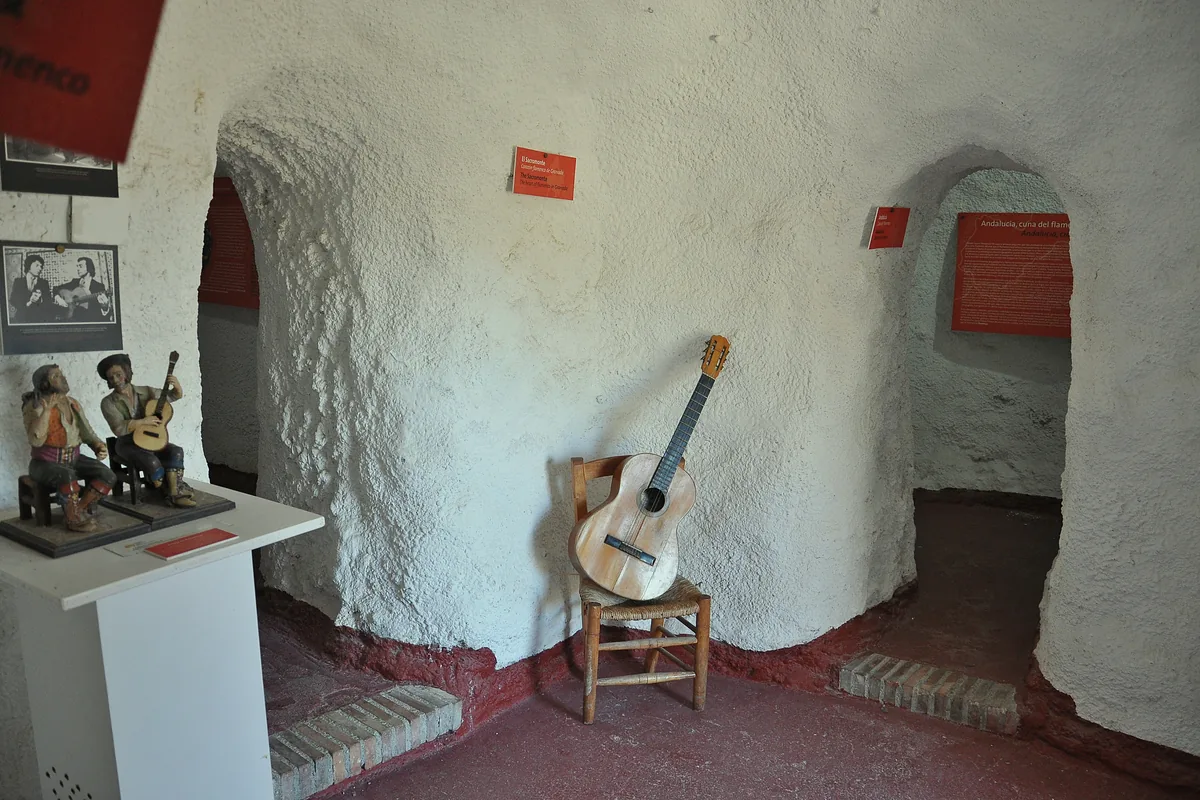
Spanish Wikipedia says zambras began in tablaos inside the cave homes of the Sacromonte and later became a major attraction for visitors. English Wikipedia's article on the district records that the zambra originated there, and that in 1985 the singer Curro Albaicín gathered veteran Sacromonte artists in an attempt to revive a zambra that had almost died out. That history explains why a cave show is the natural place to meet the dance.
Zambra at Cueva La Faraona
The venue's history page says La Faraona, born in 1896, led her own zambra, and that in 1947 she founded the Zambra La Faraona, a family tablao that is still active in the Sacromonte. The venue's home page describes a zambra as more than a show: a celebration of the soul. The ticket described here is for a flamenco show, so the setting and the history are certain, but a zambra on a given night is not promised.
How to watch it
Watch the hands as much as the feet. The finger cymbals mark the beat and the arms trace the shape of the music. Look at the costume: Wikipedia mentions a knotted blouse and a close-fitting skirt that opens into a ruffle at the bottom. Clapping is welcome when the audience around you joins in, and in a cave for 25 you will hear the cymbals clearly. After the show, the guide to palos explains the other styles you may have heard.
Frequently asked questions
What is zambra?
A flamenco dance linked to the Romani of Granada and Almería, danced barefoot with finger cymbals, according to Wikipedia.
Will I see zambra at La Faraona?
Not necessarily. The ticket is for a flamenco show, and programmes change from night to night.
Where does the word come from?
Wikipedia traces it to Andalusi Arabic zamra, which goes back to classical Arabic zamr.
Sources