How the caves work
Sacromonte's caves, explained
How the Sacromonte cave homes were made and lived in, who settled the hill, and what a cave means when you sit down for a flamenco show inside one.
Book flamenco in the Sacromonte cave ↗Quick answer
The Sacromonte caves are houses dug into a hillside opposite the Alhambra. A vertical cut forms the facade, an arch becomes the door, and rooms are excavated behind, then whitewashed with lime. The district has been the traditional neighbourhood of Granada's Romani since the 1492 conquest, and some caves now host flamenco.
A hill across from the Alhambra
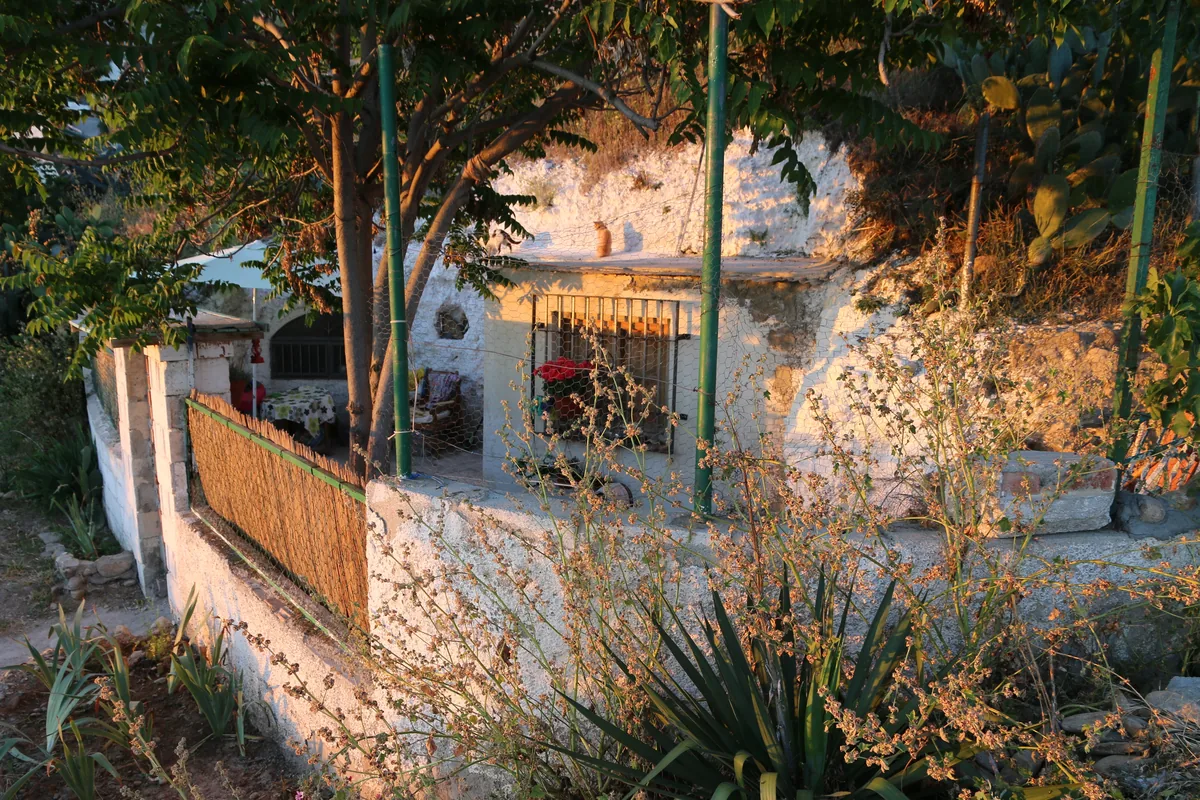
Wikipedia places the Sacromonte on a hillside and in the Valparaíso valley, opposite the Alhambra. The Darro river runs through the area, and the district spans both banks, the article adds.
How a cave is built
Wikipedia gives the method in three steps. A vertical cut in the hillside forms the facade. An arch is set in at the midpoint to serve as the door. Rooms are then excavated as far as the terrain allows. It adds that no two caves are identical, which is easy to believe given that each follows the ground it was cut from. Spanish Wikipedia says the interiors were whitewashed with lime.
Where the idea came from
The origin of the cave homes is not very clear, Wikipedia says, though building is presumed to have started in the 16th century, after the expulsion of Jews and Muslims, when the caves housed people marginalised and kept outside the city's administrative and church control. Spanish Wikipedia notes that some caves formed naturally through geological processes and were later used for their thermal conditions and security.
Who settled the hill
The Sacromonte has been the traditional neighbourhood of Granada's Romani since they settled there after the Christian conquest of 1492, Wikipedia says. Its Romani residents speak Caló, a mixed language whose use has declined rapidly over the past century. Federico García Lorca, the poet, drew them in his Romancero Gitano. Spanish Wikipedia calls the district the traditional outskirts of Granada's gitanos.
A museum of caves
Wikipedia says the Sacromonte Caves Museum opened in 2002 and covers 4,800 square metres, with up to 11 caves open to view. One cave is devoted to the history of flamenco in the Sacromonte and another to troglodyte architecture. The Darro valley has held Site of Cultural Interest status since 2016. A museum visit shows how the rooms were furnished, which makes a flamenco show in a cave easier to picture.
The poet's hill
In his Romancero Gitano, Wikipedia says, Federico García Lorca painted a portrait of the Romani of the Sacromonte. He was also the most active promoter, after Manuel de Falla, of the Concurso de Cante Jondo held at the Alhambra in June 1922; the article on that contest places the rising slopes of the Sacromonte, the Gypsy quarter, to the north of the venue. The hill has therefore been part of Granada's idea of flamenco for a century, long before it became a stop on a visitor's evening.
Flamenco in a cave
Spanish Wikipedia calls the Sacromonte the cradle of Granada's flamenco and says zambras began in tablaos inside cave homes. Today a small cave show such as the one at Cueva La Faraona, limited to 25 spectators, keeps that format: a rounded whitewashed room, the audience close, the dancers on the floor in front. The booking page for the show lists the address as Camino del Sacromonte 53.
Frequently asked questions
Are the caves natural?
Mostly dug by hand, but Spanish Wikipedia says some formed naturally and were later adapted.
Why are they white?
Spanish Wikipedia says the interiors were whitewashed with lime.
Can visitors go inside one?
Yes: the Sacromonte Caves Museum shows cave rooms, and some caves hold flamenco shows.
Sources